
Becoming a leader in data analysis is crucial to ensure business success. Out of many innovative AI-based tools, ChatGPT is at your disposal and is meant to streamline your work.
ChatGPT is the most valuable tool for chat data analysts, allowing them to conduct exploratory data analysis, write code, produce informative visualizations, and implement complex statistical modeling.
In short, by integrating ChatGPT into your workflow, you can save your time, and boost your efficiency as a data analyst. However, for that, you require good knowledge of using this tool.
By means of this blog, we’ll help you understand the use of ChatGPT in data analysis, its enormous benefits, and a few limitations.
Ready? Let’s dive in!
ChatGPT in Data Analysis
Data analysis is defined as the practice of identifying, cleaning, and modifying data to extract valuable information, and improve decision-making.
ChatGPT is one such AI tool that has been creating waves in this industry. It is a helpful tool for data analysts because of its ability to interpret and address natural language inquiries.
How ChatGPT Can Be Used in Data Analysis?
Analyzing data has now become easy because of ChatGPT. Want to know how? Here we have given a few examples:
-
Data Visualization:
While ChatGPT can’t develop graphics without the code interpreter plugin, it can be a useful tool when it comes to data visualization.
It can assist you in coming up with new ideas informative charts as well as graphs. These will allow you and your audience to comprehend the relationships between your datasets.
-
Generating Code Snippets
ChatGPT can create code snippets from natural language descriptions.
For example, if a data analyst has to develop a Python script to clean as well as preprocess a dataset, they need to write in simple English to ChatGPT, “Create a Python code snippet to eliminate null values from a pandas DataFrame.”
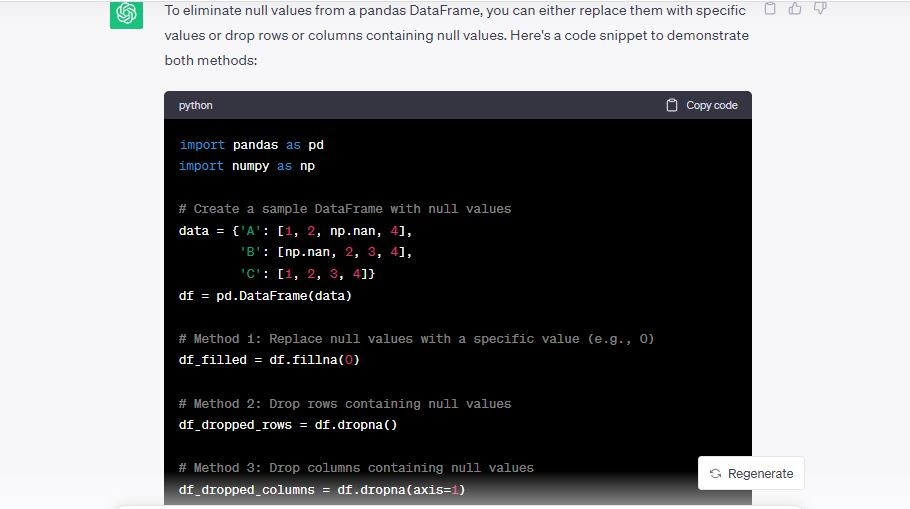
Once you click enter, the appropriate code snippet will display on the screen, thus saving the efforts and time of the analyst.
-
Exploratory Data Analysis
Exploratory data analysis (EDA) becomes easy with this AI tool. By utilizing ChatGPT, you can:
- Get guidance on which relationships to study.
- Receive suggestions for data transformations.
- Get valuable summary statistics based on your datasets.
Even today many data science certification providers are educating learners on how to use ChatGPT to perform EDA effectively.
-
Optimizing SQL Queries
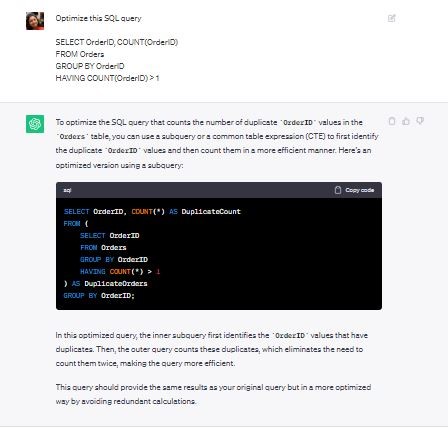
ChatGPT can easily optimize SQL queries and make data retrieval highly efficient.
For example, an analyst could enter an SQL query into ChatGPT and ask, “Optimize this SQL query” ChatGPT will provide you with recommendations for optimizing the query, saving the time and resources of a data analyst.
-
Complete Understanding of Existing Code
For data analysts working with pre-existing code, ChatGPT can help understand what the code does. This can be particularly useful when working with large codebases or when taking over a project from another analyst.
ChatGPT can assist data analysts in understanding the pre-existing code like how it performs. This aids in dealing with massive codebases.
-
Sentiment Analysis
Besides code generation, ChatGPT has the ability to perform sentiment analysis on massive text data.
Being a data analyst, can take advantage of this tool to understand social media presence, customer feedback, or internal company communications.
-
Recommendations
ChatGPT can provide recommendations for your data analysis initiatives to ensure better decision-making. ChatGPT can:
- Recommend related features for model construction and analysis utilizing ML.
- Provide practical approaches to response to data quality problems.
- Guide on picking the ideal analytics tools and techniques for your particular use case.
Advantages of Using ChatGPT for Data Analysis
ChatGPT is beneficial for data analysts in multiple ways. It prepares them to deal with certain challenges that arise during data visualization.
Here are the top benefits of utilizing ChatGPT for data analysis.
- Easy Access to Information: While performing analytical activities, data analysts often need to access documentation, and libraries.
ChatGPT can decrease the amount of time spent searching for resources by addressing queries, describing concepts, and sharing code snippets.
- Machine Learning Guidance: Data analysts used to work with ML models to gain insights or develop predictive models.
ChatGPT can help in choosing suitable ML algorithms, model evaluation methods, etc. Utilizing this tool, analysts can make informed decisions and modify their models.
- Instant Support: Data analysts can depend on ChatGPT as an on-demand support system. They can ask queries, look for clarifications, or request guidance on certain data analysis topics.
ChatGPT can give instant responses, enabling analysts to win over roadblocks or get insights effectively.
- Data Pre-processing and Cleaning: Data analysts invest a great amount of time in preparing and cleansing data before analysis.
ChatGPT can give recommendations on data pre-processing techniques, dealing with missing values, and resolving quality-related problems in customer data.
- Managing Large Datasets: Data analysts most probably work with huge datasets that can require more time to process and analyze.
ChatGPT can help in managing such datasets that can enable analysts to reorganize their workflow and boost productivity.
Limitations of ChatGPT
While ChatGPT is a great tool, it is vital to understand its limitations.
As an AI, it does not comprehend the context like a human would. It creates responses based on patterns learned during training, and while these responses can be extremely precise, they can also be incorrect.
Based on these limitations, it is essential to supplement ChatGPT’s responses with domain expertise as well as verification from other sources.
While ChatGPT can give fast insights and create code snippets, it’s always ideal to double-check these insights and code with different trustworthy sources. This ensures that the insights are right and that the code is free of bugs and effective.
Wrapping Up
AI tools such as ChatGPT are irreplaceable assets to ensure smooth data analysis. We can make the most of this tool and harness its potential to produce insights and innovation in data analysis by recognizing its strengths and limits.